
Underwater spectroscopy allows researchers to measure how submerged objects and ecosystems interact with light. By collecting high-resolution reflectance data beneath the water surface, scientists can evaluate biological health, monitor environmental change, characterize benthic habitats, and support aquatic ecosystem research.
From coral reefs and seagrass beds to freshwater lakes and coastal environments, underwater spectroscopy provides quantitative measurements that reveal information not visible through traditional observation methods.
Quick Answers
What is Underwater Spectroscopy?
Underwater spectroscopy is the measurement of reflected light from submerged objects and aquatic environments to identify biological, chemical, and physical characteristics. Researchers use field spectroradiometers to monitor coral reefs, aquatic vegetation, benthic habitats, sediments, and water quality while collecting quantitative reflectance measurements that support ecological research and remote sensing.
Underwater Spectroscopy Measures How Submerged Objects Interact with Light
Underwater spectroscopy is the measurement of reflected light from submerged objects and environments across a broad range of wavelengths. Using a field spectroradiometer, researchers collect spectral signatures that reveal the optical characteristics of underwater targets such as coral reefs, seagrass beds, algae, sediments, rocks, and aquatic vegetation.
Every natural material reflects light differently. Healthy coral reflects light differently than diseased coral. Living seagrass has a different spectral response than decaying vegetation. Sand, limestone, algae, and submerged vegetation each possess unique spectral fingerprints.
Rather than relying on photographs or visual inspection alone, spectroscopy produces quantitative reflectance data that can be analyzed statistically and compared over time.
Because many biological and environmental changes alter reflectance before visible symptoms appear, spectroscopy is often capable of detecting early indicators of ecosystem stress that conventional observation methods may miss.
Why Researchers Use Underwater Spectroscopy

Detecting Environmental Change Before It Becomes Visible
Aquatic ecosystems are dynamic environments where biological, chemical, and physical processes constantly influence one another. Environmental stressors such as warming water temperatures, pollution, invasive species, nutrient loading, sedimentation, and disease often produce subtle physiological changes long before they create obvious visual symptoms.
Spectroscopy allows researchers to monitor these changes by measuring alterations in reflected light associated with:
- Pigment concentration
- Chlorophyll content
- Tissue degradation
- Photosynthetic activity
- Structural changes
- Sediment composition
- Algal growth
- Water quality
- Biological stress
Because these characteristics influence reflectance across visible and near-infrared wavelengths, hyperspectral measurements provide a sensitive method for monitoring ecosystem health without disturbing the environment being studied.
For many applications, spectroscopy functions as an early-warning system, allowing researchers to identify areas requiring closer investigation before significant ecological damage occurs.
Applications of Underwater Spectroscopy
Coral Reef Monitoring
Coral reefs are among the world’s most biologically productive ecosystems while also being among the most vulnerable. Rising ocean temperatures, disease outbreaks, pollution, and ocean acidification continue to threaten reef systems around the globe.
Traditional coral assessments often depend on visual surveys, laboratory testing, or microbial analysis. While these methods remain valuable, they can be time consuming and may not detect early physiological changes.

Field spectroscopy provides an additional layer of information by measuring subtle changes in coral reflectance that correspond to pigment concentrations, tissue integrity, skeletal exposure, and biological stress.
Recent research has demonstrated that underwater hyperspectral measurements can distinguish healthy coral colonies from diseased specimens using spectral signatures alone. Researchers have also identified diagnostic wavelength regions associated with coral bleaching, microbial activity, and tissue degradation, creating new opportunities for non-destructive reef monitoring.
As restoration programs expand worldwide, underwater spectroscopy is becoming an increasingly important tool for monitoring reef recovery and evaluating conservation efforts over time.
Seagrass and Aquatic Vegetation Monitoring
Seagrass meadows provide critical habitat for fish, stabilize sediments, improve water quality, and capture significant amounts of carbon.
Monitoring these ecosystems requires accurate information about species distribution, vegetation density, seasonal growth patterns, and overall health.
Underwater spectroscopy allows researchers to distinguish between different aquatic plant communities based on their unique spectral signatures while also detecting changes associated with nutrient availability, disease, or environmental stress.
These measurements help support:
- Habitat restoration
- Carbon sequestration research
- Coastal management
- Biodiversity assessments
- Long-term ecological monitoring
Benthic Habitat Mapping
Understanding the composition of the seafloor is essential for marine biology, fisheries management, coastal engineering, and environmental conservation.
Different bottom materials including sand, rock, coral, algae, shell fragments, and submerged vegetation each exhibit distinct spectral characteristics.
Field spectroscopy enables researchers to build spectral libraries that improve habitat classification and validate airborne or satellite remote sensing imagery.
These measurements contribute to more accurate benthic habitat maps while reducing uncertainty in larger-scale remote sensing projects.
Freshwater Ecosystem Research
Although often associated with marine environments, underwater spectroscopy is equally valuable in freshwater systems.
Researchers use spectral measurements to study:
- Lakes
- Rivers
- Reservoirs
- Wetlands
- Streams
Applications include monitoring aquatic vegetation, assessing ecosystem health, evaluating restoration projects, identifying invasive species, and supporting water resource management.
Because freshwater systems frequently experience rapid environmental change, repeatable spectral measurements provide an effective way to monitor long-term ecological trends.
Water Quality Assessment
Water quality directly influences every aquatic ecosystem.
Changes in suspended sediments, dissolved organic matter, algae, and biological productivity all affect how light moves through the water column.
While spectroscopy does not replace laboratory water chemistry, it provides valuable optical measurements that help researchers understand changing environmental conditions.
Combined with traditional sampling methods, spectral data supports studies involving:
- Harmful algal blooms
- Turbidity
- Sediment transport
- Coastal runoff
- Restoration monitoring
- Ecosystem resilience
Why In-Situ Field Spectroscopy Matters
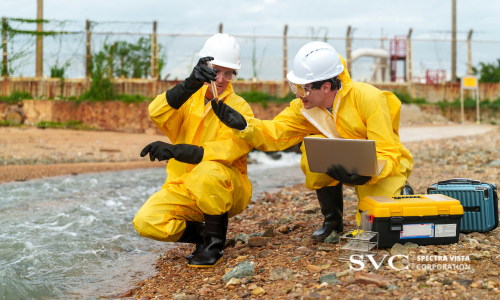
Ground Truth for Remote Sensing
Satellite imagery provides extraordinary spatial coverage, but satellites cannot replace measurements collected directly in the field.
Field spectroscopy serves as the foundation for remote sensing by providing high-quality reference data used to calibrate and validate airborne and satellite observations.
These ground-truth measurements improve classification accuracy, refine analytical models, and increase confidence in remote sensing products used across environmental science.
Underwater spectroscopy is particularly valuable because aquatic environments present unique optical challenges. Water depth, turbidity, surface conditions, and changing illumination all influence reflectance measurements. Collecting calibrated spectral data in the field helps researchers account for these variables while improving the reliability of larger-scale observations.
Challenges of Underwater Spectroscopy
Collecting accurate spectral measurements beneath the water’s surface requires careful attention to environmental conditions.
Researchers must account for:
- Water absorption
- Light scattering
- Water depth
- Surface wave conditions
- Sun angle
- Water clarity
- Measurement geometry
- Instrument calibration
Modern underwater spectroradiometers are designed to address these challenges by providing calibrated reflectance measurements using simultaneous radiance and irradiance observations. Combined with high-quality reference panels and standardized collection procedures, these systems produce repeatable measurements suitable for long-term scientific studies.
The Future of Underwater Spectroscopy
Advances in hyperspectral sensing, artificial intelligence, autonomous platforms, and cloud-based analytics are expanding the role of underwater spectroscopy across marine and freshwater research.
Future applications are likely to include:
- Autonomous underwater monitoring systems
- Machine learning-based habitat classification
- AI-assisted disease detection
- Real-time ecosystem monitoring
- Climate resilience studies
- Digital twins of aquatic environments
- Integration with drones and satellite imagery
As these technologies mature, field spectroscopy will continue to provide the high-quality reference data needed to validate increasingly sophisticated environmental monitoring systems.
Why Spectra Vista?
Reliable underwater measurements begin with reliable instrumentation.
Spectra Vista’s underwater spectroradiometers are designed to collect high-resolution reflectance measurements directly in aquatic environments, supporting applications ranging from coral reef research and benthic habitat mapping to freshwater ecosystem studies and remote sensing validation.
By combining simultaneous radiance and irradiance measurements with high spectral resolution and robust field-ready design, researchers can collect consistent, repeatable data in challenging underwater conditions while maintaining the measurement quality required for scientific research.
Whether supporting long-term ecological monitoring, validating satellite imagery, or investigating new environmental applications, Spectra Vista instruments provide researchers with the tools needed to capture accurate spectral information where conventional methods often fall short.
See What Spectra Vista Can Do for Your Application
Frequently Asked Questions
What are marine ecological studies?
Marine ecological studies examine the relationships between aquatic organisms and their environments. Researchers investigate coral reefs, coastal habitats, freshwater lakes, rivers, wetlands, aquatic vegetation, sediments, and water quality to better understand ecosystem health, biodiversity, and environmental change.
How does field spectroscopy support aquatic ecosystem monitoring?
Field spectroscopy measures reflected light across hundreds of wavelengths, allowing researchers to identify subtle changes in vegetation health, coral condition, sediment composition, and environmental stress. These quantitative measurements complement ecological surveys, laboratory analyses, and remote sensing by providing consistent, repeatable field data.
Can spectroscopy detect coral bleaching?
Yes. Changes in coral pigmentation and the health of symbiotic algae alter a coral’s spectral reflectance before bleaching becomes severe. Field spectroscopy enables researchers to detect these optical changes, making it a valuable tool for monitoring coral health, evaluating restoration efforts, and supporting reef conservation programs.
What is the difference between underwater spectroscopy and remote sensing?
Underwater spectroscopy collects high-resolution reflectance measurements directly within aquatic environments using field instruments. Remote sensing uses airborne or satellite sensors to observe larger areas from above. Field spectroscopy provides the ground-truth data needed to calibrate, validate, and improve the accuracy of remote sensing products.
How is spectroscopy used to monitor lakes?
Researchers use field spectroscopy to assess aquatic vegetation, evaluate water quality, monitor harmful algal blooms, characterize sediments, and track seasonal ecological changes. These measurements support limnology research, reservoir management, wetland restoration, and long-term environmental monitoring.
What types of aquatic habitats can be studied using field spectroscopy?
Field spectroscopy is used across a wide range of aquatic environments, including coral reefs, seagrass meadows, kelp forests, estuaries, mangrove ecosystems, wetlands, lakes, rivers, reservoirs, and coastal habitats. It helps researchers measure ecosystem condition and monitor environmental change across both marine and freshwater systems.
Why is ground-truth data important?
Ground-truth data consists of measurements collected directly in the field to verify and improve remote sensing observations. By comparing field spectroscopy data with drone or satellite imagery, researchers can increase the accuracy of habitat classification, vegetation mapping, and environmental monitoring models.
What instruments are used for aquatic field spectroscopy?
Aquatic field spectroscopy is typically performed using field spectroradiometers designed to measure reflectance under natural environmental conditions. Depending on the application, researchers may also use underwater accessories, calibrated reflectance reference panels, GPS systems, and environmental sensors to ensure accurate, repeatable spectral measurements.
Related Articles

Ground-Truth Spectroscopy Reveals the Source of a Southern Ocean Satellite Bias
New research using field spectroscopy in Antarctic waters suggests that a long-standing underestimate of chlorophyll-a from satellite observations may have less to do with the

Satellite Ocean Color Validation: Field Spectroscopy Remains Essential for Ground Truth Analysis
Satellites have transformed our ability to monitor Earth’s oceans. From tracking phytoplankton blooms and coastal water quality to measuring global carbon cycling, today’s Earth observation
Underwater Field Spectroscopy for Coral Health Monitoring
Coral reefs support some of the most biologically diverse ecosystems on Earth, yet they are increasingly threatened by disease, environmental stress, and changing ocean conditions.