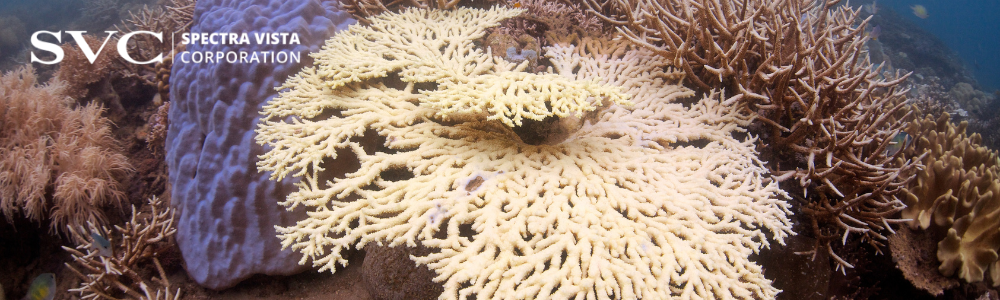
Underwater Field Spectroscopy for Coral Health Monitoring
Coral reefs support some of the most biologically diverse ecosystems on Earth, yet they are increasingly threatened by disease, environmental stress, and changing ocean conditions. Monitoring reef health has traditionally relied on visual inspections, laboratory testing, and microbial analysis, methods that can be time-consuming, invasive, and difficult to scale across large reef systems.
How Spectral Measurements Reveal Hidden Signs of Stress in Reef Ecosystems
A recent study conducted in the Red Sea demonstrates how underwater field spectroscopy may help address these challenges. By combining in-situ hyperspectral measurements with microbial analysis, researchers successfully differentiated healthy and diseased coral colonies using subtle changes in reflected light.

The study also highlights the growing role of underwater field spectroscopy as a practical tool for ecosystem monitoring. Rather than waiting for visible symptoms to appear, researchers can potentially detect biological stress through spectral signatures that reveal changes in tissue structure, pigmentation, and microbial activity.
Moving Beyond Visual Assessments
Coral diseases often begin with physiological and microbial changes that are difficult to detect through visual observation alone. By the time tissue loss, bleaching, or necrosis becomes apparent, significant damage may already be underway.
Hyperspectral spectroscopy offers a different approach.
Every biological material interacts with light in a unique way. Changes in pigment concentrations, cellular structure, microbial colonization, and tissue integrity alter how a surface absorbs and reflects energy across the electromagnetic spectrum.
These changes create measurable spectral signatures that can serve as indicators of health status.
In this study, researchers investigated whether spectral measurements could distinguish healthy coral colonies from diseased colonies before relying solely on traditional laboratory analysis. Their objective was to determine whether hyperspectral reflectance data could function as a non-destructive diagnostic tool for coral health assessment.
Measuring Coral Reflectance Underwater
Field measurements were conducted at coral reef sites near Hurghada, Egypt, in the Red Sea.
Researchers collected spectral measurements from colonies of Acropora humilis and Favia lacuna, representing both healthy and diseased specimens. Spectral data were acquired using the Spectra Vista HR-512i underwater spectroradiometer, an instrument specifically designed for in-situ aquatic measurements.
The HR-512i provides spectral coverage from 350 nm to 1050 nm with a 4-degree field of view, allowing researchers to collect high-resolution reflectance measurements directly underwater. Measurements were performed under natural illumination conditions and calibrated using a Spectralon white reference panel to ensure data consistency.
Unlike laboratory-based approaches that require sample removal, the measurements were obtained directly from living coral colonies in their natural environment. This allowed researchers to capture real-world spectral responses while minimizing disturbance to the reef ecosystem.
The ability to acquire calibrated reflectance measurements underwater is particularly important because water strongly influences light transmission. Reliable underwater spectroscopy requires instrumentation capable of accounting for changing illumination conditions, scattering effects, and environmental variability.
Spectral Differences Between Healthy and Diseased Corals
Lorem ipsum dolor sit amet,
The study revealed clear differences in reflectance characteristics between healthy and diseased coral colonies.
Across both coral species, diseased colonies consistently exhibited higher reflectance values than healthy colonies throughout much of the visible and near-infrared spectrum.
Several wavelength regions proved especially significant:
- Approximately 450 nm (blue region)
- Approximately 500–600 nm (green to red region)
- Approximately 700–800 nm (red-edge and near-infrared region)
Healthy corals generally exhibited lower reflectance because pigments associated with photosynthetic symbionts absorbed incoming light more effectively.
Diseased corals, by contrast, reflected more energy. Researchers attributed this increase to factors including pigment degradation, tissue thinning, skeletal exposure, and microbial colonization.
These optical changes created measurable spectral distinctions that allowed healthy and diseased colonies to be separated using statistical analysis.
Importantly, these differences were observed without destructive sampling and before considering the microbial data, demonstrating the diagnostic potential of spectral measurements alone.
Looking Deeper with Derivative Spectroscopy
While raw reflectance curves revealed important differences, the researchers also applied second-derivative analysis to enhance subtle spectral features.
Derivative spectroscopy is commonly used in hyperspectral analysis to isolate absorption features that may be difficult to detect in raw data. The technique reduces baseline effects and improves sensitivity to small spectral variations.
Using this approach, researchers identified several wavelength regions that repeatedly corresponded with disease-related changes:
- 450–460 nm
- 580–590 nm
- 700–800 nm
Healthy colonies displayed relatively stable spectral characteristics, including strong chlorophyll-related absorption features near 675 nm that indicated active photosynthetic symbiosis.
Diseased colonies showed broader, more variable spectral responses, suggesting physiological disruption and altered pigment composition.
The results demonstrate how derivative analysis can uncover biological information that may otherwise remain hidden within complex spectral datasets.
Connecting Spectral Measurements to Microbial Activity
One of the most interesting aspects of the study was its attempt to connect optical measurements with microbial community composition.
Researchers identified distinct bacterial communities associated with healthy and diseased coral samples.
Healthy corals were dominated by bacterial species commonly associated with stable coral microbiomes. Diseased samples contained bacterial populations linked to coral disease and physiological stress.
When spectral data and microbial profiles were analyzed together, patterns emerged showing that specific bacterial communities were associated with distinct spectral responses.
While the authors emphasize that additional research is needed to validate these relationships, the findings suggest that hyperspectral measurements may provide indirect insight into biological processes occurring within coral tissues and associated microbial communities.
This represents an important step toward using spectroscopy not only as a tool for identifying physical characteristics, but also as a method for detecting biological change.
Identifying Spectral Biomarkers for Reef Monitoring
One of the most practical outcomes of the study was the identification of spectral biomarkers that consistently differentiated healthy and diseased corals.
The researchers highlighted several wavelength regions with strong diagnostic value:
Wavelength Region
450 nm |
500 nm |
600 nm |
700 nm |
800 nm |
Potential Indicator
Pigment degradation |
Tissue thinning and microbial growth |
Reduced pigment absorption |
Tissue loss and skeletal exposure |
Advanced degradation and necrosis |
These spectral indicators provide a foundation for future monitoring systems and may help guide the development of targeted sensing approaches for reef health assessment.
Rather than analyzing hundreds of wavelengths equally, future systems may focus on a smaller number of highly informative bands that correlate strongly with biological condition.
Implications for Environmental Monitoring
Although this research focused on coral reefs, its significance extends well beyond marine ecosystems.
The fundamental principle demonstrated by the study is that biological stress alters spectral behavior in measurable ways.
The same concept underpins many applications of field spectroscopy, including:
- Crop stress detection
- Forest health monitoring
- Aquatic vegetation assessment
- Wetland management
- Ecosystem restoration monitoring
- Environmental impact assessment
In each case, spectroscopy provides a means of detecting physiological changes through reflected light before those changes become visually obvious.
As field instruments continue to improve and analytical methods become more sophisticated, spectroscopy is increasingly being used as an early-warning system for environmental change.
The Future of Underwater Field Spectroscopy
The authors describe this work as a proof-of-concept study, but the broader implications are significant.
Combining field spectroscopy with biological and environmental data creates new opportunities for monitoring ecosystem health at larger scales and with greater efficiency.
Future research may integrate underwater spectroscopy with autonomous platforms, drone systems, satellite observations, and machine learning algorithms to provide near real-time assessments of reef condition.
For marine scientists and environmental researchers, these developments could support more responsive conservation efforts and more effective management of vulnerable ecosystems.
Conclusion
Coral reef monitoring has traditionally relied on visual observations and laboratory analysis, but this study demonstrates how underwater field spectroscopy can provide an additional layer of insight.
Using in-situ hyperspectral measurements, researchers successfully distinguished healthy and diseased coral colonies based on subtle changes in reflectance across visible and near-infrared wavelengths. The resulting spectral signatures revealed information about pigment composition, tissue condition, and microbial activity without requiring destructive sampling.
While additional validation is needed, the findings reinforce a broader trend across environmental science: spectroscopy is becoming an increasingly valuable tool for detecting biological change in real-world conditions.
As researchers continue to explore new applications, underwater field spectroscopy may play an important role in helping scientists monitor and protect some of the planet’s most important marine ecosystems.
Interested in exploring the full methodology and findings?
Frequently Asked Questions
What is underwater field spectroscopy?
Underwater field spectroscopy is the measurement of reflected light from aquatic environments using spectroradiometers designed to operate beneath the water surface. Researchers use these measurements to study biological, chemical, and physical characteristics of underwater targets.
How can spectroscopy detect coral disease?
Disease can alter coral pigmentation, tissue structure, microbial activity, and skeletal exposure. These changes affect how corals absorb and reflect light, creating measurable differences in their spectral signatures.
What wavelengths were most important in this study?
Researchers identified several diagnostic wavelength regions, including 450–460 nm, 580–590 nm, and 700–800 nm, as particularly useful for differentiating healthy and diseased corals.
Why use hyperspectral measurements instead of visual inspections?
Hyperspectral measurements can detect subtle physiological changes that may not yet be visible to the human eye, providing an opportunity for earlier identification of biological stress.
What instrument was used in the study?
Researchers collected in-situ measurements using the Spectra Vista HR-512i underwater spectroradiometer.
Can field spectroscopy be used beyond coral research?
Yes. Field spectroscopy is widely used in agriculture, forestry, environmental monitoring, aquatic ecosystem assessment, geology, and remote sensing applications.
What are spectral biomarkers?
Spectral biomarkers are wavelength regions that consistently correlate with specific biological or physical conditions. They can be used as indicators of plant health, environmental stress, disease, or other measurable characteristics.
How might this research support future reef monitoring efforts?
The study demonstrates the potential for non-destructive, field-based monitoring of coral health. Future systems may combine spectroscopy with machine learning, drones, autonomous vehicles, and satellite observations to improve reef monitoring at larger scales.