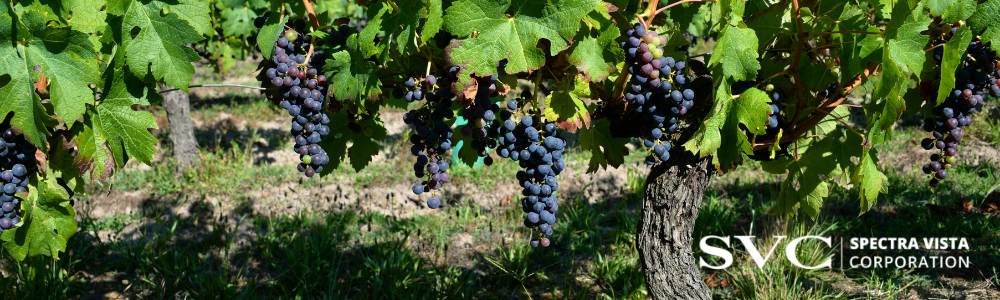
Reflectance Spectroscopy Reveals Hidden Differences Among Wine Grape Cultivars
Wine grapes may share a species name, but anyone who works in viticulture knows that not all vines respond to environmental conditions in the same way. Some cultivars maintain productivity under water stress. Others prioritize rapid growth and resource acquisition. Understanding these differences is becoming increasingly important as growers face changing weather patterns, shifting growing regions, and greater pressure to optimize vineyard management.

A recently published study in PLOS One explored whether reflectance spectroscopy can help researchers detect and measure these subtle physiological differences among wine grape cultivars. The findings suggest that hyperspectral measurements can provide valuable insights into plant performance, helping researchers characterize traits that would otherwise require time-consuming laboratory or field-based measurements.
Why Plant Traits Matter in Modern Viticulture
Climate variability is reshaping viticulture around the world. Rising temperatures, changing precipitation patterns, and more frequent drought conditions are forcing growers and researchers to rethink how vineyards are managed and which cultivars may be best suited for future conditions.
Many of the traits that influence vineyard performance are difficult to measure at scale. Characteristics such as:
- Photosynthetic capacity
- Transpiration rates
- Stomatal conductance
- Water-use efficiency
- Leaf nitrogen content
- Plant water status
can provide important clues about how a vine responds to environmental stress.
Traditionally, collecting these measurements requires specialized equipment, laboratory analysis, or labor-intensive fieldwork. As a result, sample sizes are often limited, making it difficult to evaluate large populations or monitor changes throughout a growing season.
This challenge has fueled growing interest in high-throughput phenotyping approaches that allow researchers to collect more data in less time.
Using Spectroscopy to Measure Plant Performance
Researchers from the University of Toronto Scarborough and Niagara College evaluated twelve wine grape cultivars representing seven grape varieties grown at a teaching vineyard in Ontario, Canada.
To collect spectral data, the team used an SVC HR-1024i field spectroradiometer equipped with an LC-RP Pro leaf clip. Spectral measurements were collected across the full 350-2500 nm wavelength range and compared against a suite of physiological, chemical, and morphological leaf traits.
The goal was straightforward: determine whether reflectance measurements could predict meaningful differences among closely related grape cultivars.
This is an important distinction. Previous research has demonstrated that spectroscopy can differentiate between plant species. Detecting variation within a single species presents a much more challenging problem because the physiological differences are often subtle.
Significant Variation Exists Within a Single Crop Species
The researchers found substantial differences among cultivars, particularly in traits associated with water use and resource acquisition.
Some cultivars exhibited:
- Higher photosynthetic rates
- Greater transpiration
- Increased stomatal conductance
- Different water-use efficiency strategies
These physiological traits varied far more than basic structural characteristics such as leaf carbon concentration or leaf mass per area.
The results reinforce an increasingly important concept in agricultural research: meaningful variation often exists within a crop species, not just between species.
For growers and breeding programs, understanding this variation can help identify cultivars that are better adapted to future environmental conditions.
Which Traits Can Spectroscopy Predict?
The study found that reflectance spectroscopy was capable of predicting several important plant traits with varying degrees of success.
The strongest predictive relationships were observed for:
- Leaf dry matter content (LDMC)
- Maximum photosynthetic capacity
- Transpiration rate
Moderate predictive performance was achieved for:
- Leaf nitrogen concentration
- Leaf carbon concentration
- Predawn water potential
- Leaf area
The results were less successful for certain water-related traits, including intrinsic water-use efficiency and carbon isotope signatures.
While not every trait could be predicted with the same level of accuracy, the findings demonstrate that spectral measurements can capture meaningful physiological information that would otherwise require considerably more effort to obtain.
Why the Red Edge Matters
One of the more interesting findings involved the spectral regions most closely associated with trait prediction.
The researchers identified the red-edge region, roughly 680-750 nm, as one of the most important areas for estimating plant physiological characteristics.
The red edge sits at the transition between strong chlorophyll absorption in the visible spectrum and high reflectance in the near-infrared region. Because this transition is sensitive to changes in leaf structure, chlorophyll concentration, and photosynthetic activity, it often serves as a powerful indicator of plant health.
Strong predictive signals were also observed in portions of the near-infrared and shortwave infrared regions, particularly for traits related to water status and leaf structure.
These findings align with a growing body of spectroscopy research that demonstrates how subtle spectral features can reveal information about plant function that is invisible to the human eye.
Applications Beyond the Vineyard
Although this study focused on wine grapes, the implications extend far beyond viticulture.
The same approach could be applied to:
- Crop breeding programs
- Precision agriculture research
- Drought tolerance studies
- Forestry applications
- Ecosystem monitoring
- Plant phenotyping programs
As researchers continue working to understand how plants respond to environmental stress, the ability to collect rapid, non-destructive measurements becomes increasingly valuable.
Field spectroscopy offers a practical way to bridge the gap between detailed physiological measurements and large-scale monitoring efforts.
What This Means for Spectroscopy Users
One of the most valuable takeaways from this research is that spectroscopy is not limited to broad classifications such as distinguishing one species from another.
The study demonstrates that hyperspectral measurements can reveal meaningful variation among closely related cultivars within a single crop species.
For researchers, that means the possibility of evaluating larger populations, screening breeding materials more efficiently, and tracking physiological responses across entire growing seasons.
For agricultural applications, it highlights the growing role of field spectroscopy as a tool for understanding plant performance before visible symptoms appear.
As climate adaptation becomes an increasingly important priority for growers worldwide, the ability to rapidly assess plant traits may help researchers and producers make more informed decisions about cultivar selection, water management, and long-term vineyard resilience.
Who Should Read this Research?
Frequently Asked Questions
What are leaf traits in wine grapes?
Leaf traits are measurable characteristics that describe how grapevine leaves function and respond to their environment. These traits can include photosynthetic capacity, transpiration rate, water-use efficiency, leaf nitrogen content, leaf dry matter content, and other indicators of plant health and performance. Researchers use these measurements to better understand how grape cultivars respond to environmental conditions such as drought, heat, and changing growing seasons.
What is reflectance spectroscopy?
Reflectance spectroscopy is a non-destructive measurement technique that analyzes how leaves reflect light across a wide range of wavelengths. Because plant pigments, water content, and leaf structure influence reflected light, spectral measurements can reveal information about plant physiology that is not visible to the human eye.
Why is spectroscopy useful for vineyard research?
Traditional methods for measuring photosynthesis, water status, and leaf chemistry often require specialized laboratory equipment and significant time in the field. Reflectance spectroscopy allows researchers to collect large amounts of data quickly, making it possible to evaluate more plants and monitor changes throughout an entire growing season.
Can spectroscopy detect differences between grape cultivars?
Yes. This research found that reflectance spectroscopy was able to identify differences among closely related wine grape cultivars. The study demonstrated that spectral measurements could capture variation in traits related to photosynthesis, transpiration, leaf chemistry, and plant water relations.
Which grapevine traits were predicted most accurately?
The strongest predictive relationships were observed for leaf dry matter content (LDMC), maximum photosynthetic capacity, and transpiration rate. Moderate success was achieved for leaf nitrogen concentration, leaf carbon concentration, predawn water potential, and leaf area.
Can reflectance spectroscopy measure plant water stress?
The study found that reflectance spectroscopy can provide useful information related to plant water status and water-use strategies, although some water-related traits remain more challenging to predict than structural or physiological traits. The results suggest that spectroscopy may support drought monitoring and irrigation management applications.
What is high-throughput plant phenotyping?
High-throughput phenotyping refers to techniques that allow researchers to measure plant characteristics rapidly and at larger scales than traditional methods. Reflectance spectroscopy is increasingly used as a high-throughput phenotyping tool because it can collect detailed plant information quickly and without damaging the plant.
Why is water-use efficiency important in viticulture?
Water-use efficiency describes how effectively a plant converts water into growth through photosynthesis. Cultivars with higher water-use efficiency may be better suited to drought-prone environments or regions experiencing increased climate variability. Understanding these differences can help guide vineyard management and cultivar selection decisions.
What wavelengths were most important for predicting grapevine traits?
The study identified the red-edge region (approximately 680-750 nm), near-infrared wavelengths, and portions of the shortwave infrared spectrum as particularly important for predicting plant traits. These regions are sensitive to leaf structure, chlorophyll content, water content, and photosynthetic activity.
What is the red-edge region in plant spectroscopy?
The red-edge is the transition zone between red light absorption by chlorophyll and strong reflectance in the near-infrared spectrum. Changes in the position and shape of the red-edge can provide information about plant health, photosynthetic activity, and stress responses.
How can grape growers benefit from this type of research?
As climate conditions continue to change, growers need better tools to evaluate vine performance, drought tolerance, and cultivar suitability. Research like this helps demonstrate how spectroscopy can support faster assessment of plant health and physiological performance, potentially improving vineyard management decisions.
Are these findings limited to wine grapes?
No. While this study focused on wine grapes, the underlying methods can be applied to many agricultural crops, forestry applications, ecological studies, and plant breeding programs. The broader significance lies in demonstrating that spectroscopy can detect meaningful differences within a single species, not just between different species.
What instrument was used in this research?
Researchers collected spectral measurements using an SVC HR-1024i field spectroradiometer paired with an LC-RP Pro leaf clip. This configuration enabled non-destructive measurements across the 350-2500 nm spectral range while maintaining consistent illumination and measurement conditions.
Where can I read the original research paper?
The complete study, Predicting Leaf Traits in Wine Grapes with Reflectance Spectroscopy, is available through PLOS One. Readers interested in the methodology, statistical analysis, and detailed findings are encouraged to review the full publication.